
SEO Best Practices: The Complete Guide (2026)
SEO has changed more in the last two years than in the previous decade. AI Overviews, zero-click searches, and answer engines like ChatGPT and Perplexity are reshaping how people discover information. Yet businesses that follow modern SEO best practices continue to generate consistent traffic, leads, and revenue from organic search.
Search engine optimization best practices are the proven methods that help rank higher by aligning with search engine algorithms and user intent. They not only focus on quality content but also on technical health and authority-building strategies. These are not shortcuts but sustainable approaches that improve visibility and connect SEO performance directly to business outcomes.
This SEO guide outlines the most effective tactics for link building, on-page optimization, technical SEO, and content strategy. It also explains how success can be measured through clear KPIs and highlights common mistakes that can lead to penalties.
Table of Contents
- What Is SEO and Why Does It Still Matter?
- Technical SEO Best Practices
- On-Page SEO Best Practices
- Content Strategy Best Practices
- Link Building Best Practices
- How to Measure SEO Performance
- Common SEO Mistakes to Avoid
- SEO Best Practices Checklist
What Is SEO and Why Does It Still Matter in 2026?
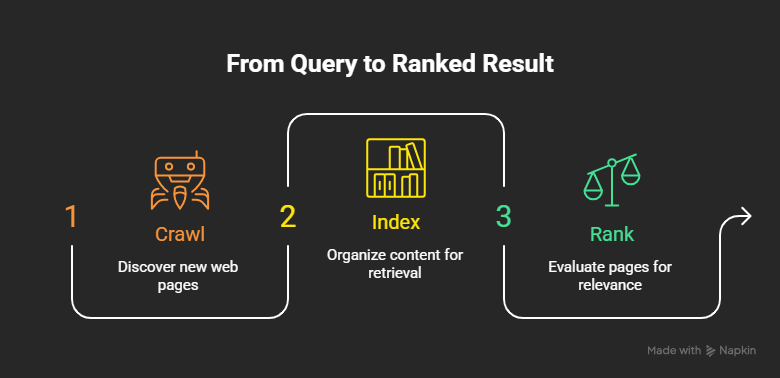
Search engine optimization (SEO) is the practice of improving a website so that it ranks higher in search results and attracts more relevant visitors. Search engines follow a simple process: they crawl pages to discover content, index them to store information, and then rank results based on relevance and authority.
Organic traffic remains one of the most valuable sources of visitors. Unlike paid ads, which stop delivering once the budget runs out, organic visibility compounds over time. It builds trust with audiences, reduces long-term acquisition costs, and provides consistent exposure.
Today, Google’s ranking factors emphasize E-E-A-T (Experience, Expertise, Authoritativeness, Trustworthiness), alongside relevance, authority, and user experience. This means content must not only answer queries but also demonstrate credibility and reliability. Sites that combine technical health with strong content and trustworthy signals are more likely to sustain rankings.
SEO matters because it connects businesses with audiences actively searching for solutions. It is not a quick trick but a system that rewards quality, consistency, and authority. In 2026, as AI-driven search reshapes search results, SEO best practices remain the foundation for visibility and growth.
Technical SEO Best Practices
Technical SEO is the foundation. If crawlers cannot access your pages or your pages load slowly on mobile, nothing else matters. Fix this first.
Site Speed and Core Web Vitals
Core Web Vitals became official ranking signals in 2021 and act as a tiebreaker between competing pages of similar quality in 2026.
Key Metrics for Site Speed and Stability
|
Metric |
What It Measures |
Pass Threshold |
| LCP (Largest Contentful Paint) | How fast does the main content load | Under 2.5 seconds |
| INP (Interaction to Next Paint) | How quickly the page responds to interaction | Under 200 milliseconds |
| CLS (Cumulative Layout Shift) | Whether elements jump around as the page loads | Score below 0.1 |
Swappie improved LCP by 55% and saw a 42% jump in mobile revenue.
Vodafone cut LCP by 31% and recorded an 8% increase in sales. A 0.1-second improvement in load time boosts conversions by up to 8%.
Convert images to WebP, add lazy loading, deploy a CDN, and remove render-blocking JavaScript.
Recommended Tools: Google PageSpeed Insights, Lighthouse, Search Console CWV report
Crawlability and Indexability
- Robots.txt basics: Control which pages bots can crawl.
- XML sitemaps: Help search engines discover and organize pages; submit via Google Search Console.
- Fixing crawl errors: Identify and resolve issues in GSC reports.
Mobile‑First Optimization
- Why it matters: Google indexes mobile versions first.
- Checklist: Responsive design, fast load times, touch‑friendly navigation.
Structured Data (Schema Markup)
- Definition: Code that helps search engines understand content and earn rich results.
- Useful Types: Article, FAQ, HowTo, Product.
The Technical SEO provides extended practices and examples.
Recommended Tools: Use Screaming Frog, Ahrefs Site Audit, and Google Search Console to diagnose technical issues and monitor site health.
Read more: Technical SEO Guide
On-Page SEO Best Practices
On-page SEO remains one of the most controllable aspects of search optimization. It ensures that each page is structured so search engines can understand it while also delivering clarity and value to readers. The following practices represent the essentials for 2026.
Keyword Placement
Keywords should appear in the title, H1, the first 100 words, and the URL. Placement matters more than repetition. Natural use is critical, as keyword stuffing can harm rankings and user experience. Semantic SEO and LSI keywords help search engines interpret context, making content more relevant and comprehensive.
Title Tags and Meta Descriptions
- Title tag – 50 to 60 characters, primary keyword near the front, include a year or power word to improve CTR. Google rewrites title tags 76% of the time. Write the best version you can.
- Meta description – 150 to 160 characters, summarize the page value, include the keyword naturally, and end with an implicit call to action.
- Never duplicate either across pages.
Header Tag Hierarchy (H1–H6)
Every page should contain only one H1. Subheadings (H2, H3) organize content for readers and crawlers, creating a logical flow. Proper hierarchy signals importance and improves readability.
URL Structure
URLs should be short, descriptive, and keyword-rich. Hyphens are preferred over underscores. Dynamic parameters should be avoided where possible, as clean URLs are easier for both users and search engines to process.
Image Optimization
Images should use descriptive file names and alt text to improve accessibility and relevance. WebP format is recommended for faster loading, with file sizes kept small to reduce page speed issues. Image sitemaps help search engines discover and index visuals effectively.
Each new piece of content should include 3–5 internal links. Anchor text must be descriptive and keyword-rich. Linking from high-authority pages accelerates ranking for new content. All important pages should be reachable within three clicks from the homepage. Further strategies are detailed in the On-Page SEO.
Quick-Reference Checklist: On-Page SEO
- Primary keyword in title, H1, first 100 words, URL
- Natural keyword use, avoid stuffing
- Include LSI and semantic keywords
- Title tag length: 50–60 characters
- Meta description length: 150–160 characters
- Unique titles across all pages
- One H1 per page
- Short, descriptive, keyword-rich URLs
- Optimized images with alt text and WebP format
- 3–5 internal links per new page
Read more: On-Page SEO Guide
Content Strategy Best Practices for SEO
A strong content strategy is the backbone of effective SEO. It ensures that every piece of content is purposeful, aligned with search intent, and structured to build authority. The following practices highlight the essentials for 2026.
1. Keyword Research Fundamentals

Source Image:- cdn.searchenginejournal.com
Evaluate every target keyword across three metrics:
- Search Volume – how many monthly searches. Higher is not always better if you cannot realistically rank.
- Keyword Difficulty (KD) – 0 to 100 scale. Newer sites should target under 30. Established sites can go higher.
- CPC – what advertisers pay per click. High CPC signals commercial value even for organic content.
Balance your content mix across head terms (1 to 2 words, high competition), body keywords (2 to 3 words, moderate), and long-tail keywords (4+ words, lower competition, higher intent).
Recommended Tools: Google Keyword Planner, Ahrefs Keywords Explorer, Semrush Keyword Magic Tool
2. Understanding Search Intent
Matching intent beats matching keywords. There are four types:
- Informational – the user wants to learn
- Navigational – the user wants a specific site
- Transactional – the user is ready to act or buy
- Commercial investigation – the user is comparing options before buying
Practical test: search for your keyword and see what Google ranks. Listicle? Product page? Guide? Match that format. A product page will not outrank informational articles for an informational keyword, regardless of optimization.
3. Topic Clusters and Pillar Pages
Modern SEO is no longer about ranking individual pages in isolation. Search engines increasingly reward websites that demonstrate comprehensive expertise across an entire subject area.
This is where topic clusters become valuable. A topic cluster consists of:
- A pillar page that covers a broad subject
- Multiple supporting articles that explore specific subtopics
- Strategic internal links connecting all related content
For example, a pillar page targeting “SEO Best Practices” could link to dedicated cluster pages covering:
- Technical SEO
- On-Page SEO
- Keyword Research
- Link Building
- Core Web Vitals
- Local SEO
- SEO Audits
When these pages are interconnected, search engines gain stronger signals about your expertise on the topic. This approach helps build topical authority, improves crawl efficiency, and creates more opportunities to rank for long-tail keywords.
Rather than publishing isolated articles, focus on building complete content ecosystems around your core topics. This strategy has become increasingly important as search engines prioritize subject expertise and topical depth.
15% of Google searches every day have never been searched before. Keyword tools only surface known demand; original content on emerging topics captures traffic before competition forms.
SEO for AI Overviews and Answer Engines
Search is evolving beyond traditional blue links. AI Overviews, answer engines optimization, and generative search experiences increasingly summarize information directly within search results.
To improve visibility in AI-driven search experiences:
- Structure content with clear headings and concise answers
- Include definitions, examples, and step-by-step explanations
- Use schema markup where appropriate
- Build authority through high-quality citations and backlinks
- Publish original insights, research, and first-hand experience
- Maintain strong E-E-A-T signals across the page
AI systems often favor content that is easy to extract, well-structured, and supported by trustworthy sources. Creating content that answers questions directly while providing deeper context can improve both traditional rankings and AI visibility.
Read more: GEO vs AEO vs SEO
Writing for E-E-A-T
Google emphasizes Experience, Expertise, Authoritativeness, and Trustworthiness (E-E-A-T). Content should demonstrate expertise through author bios, citations, and original research. Updating older content strengthens trust signals and keeps information current. Pages that reflect genuine experience and authority are more likely to rank and sustain visibility.
Content Freshness and Publishing Cadence
Freshness signals remain critical. Publishing consistently helps maintain relevance, but cadence should match resources and quality standards. Updating existing content is often more effective than rewriting or deleting, especially when pages already have authority. Deletions should be reserved for outdated or redundant material that no longer serves a purpose.
Content strategy is reinforced through internal linking. Each new article should connect to related pages, guiding crawlers and readers through the site. Linking from high-authority pages accelerates visibility for new content.
Link Building Best Practices
Backlinks remain one of Google’s top three ranking signals. They are votes of credibility. A respected site linking to your content signals to Google that it is worth ranking.
The top-ranked Google result has 3.8x as many backlinks as the pages in positions 2 through 10. 94% of all web content has zero external backlinks. And 85% of AI Overview citations come from third-party content, making link building directly relevant to AI search visibility, too.
One link from a DR 80+ domain can outweigh 100 links from low-authority sources. Fewer, better links beat bulk every time.
Why Backlinks Still Matter
Backlinks help search engines evaluate relevance and authority. They continue to influence rankings because they represent external validation. A single high-quality link can move the needle more than bulk low-value links, making strategic acquisition essential.
White-Hat Link Building Tactics
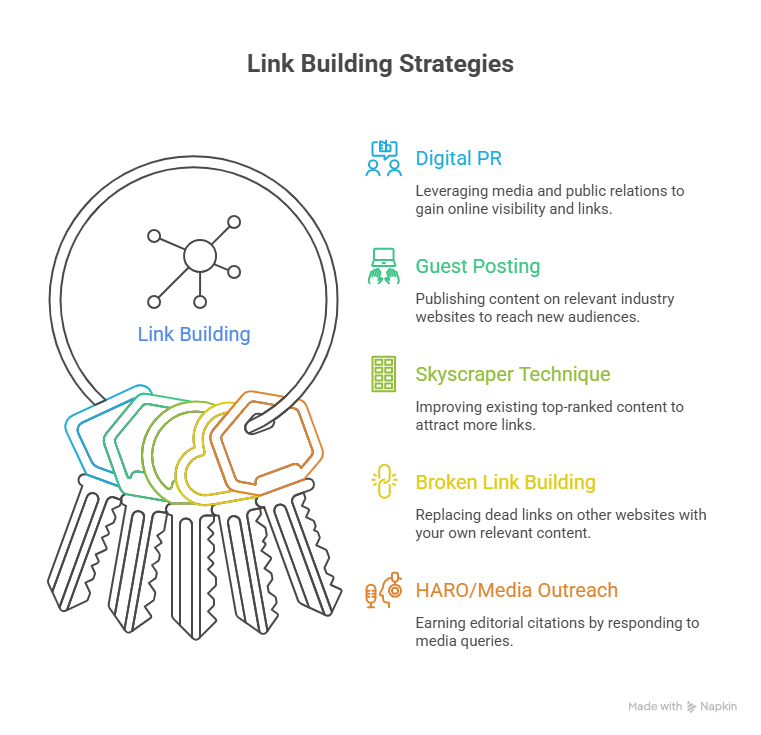
Effective link building relies on ethical, sustainable methods. Guest posting on relevant industry sites builds exposure and authority. Digital PR campaigns and data-driven content attract editorial links from high-authority publications. The skyscraper technique improves on existing popular content and earns links from sites referencing the original. Broken link building replaces dead links with fresh resources, while HARO and media outreach connect experts with journalists for citations in major outlets.
Effective White-Hat Tactics
- Digital PR – rated the most effective tactic by 48.6% of SEOs. Create original data studies or research reports. Pitch them to journalists. Earn editorial links from high-authority publications.
- Guest posting – write for relevant industry sites where your audience actually reads.
- Skyscraper technique – find the most-linked content on a topic, create something better, reach out to sites linking to the original.
- Broken link building – find dead links on authoritative sites, and offer your content as a replacement.
- HARO and media outreach – respond to journalist queries and earn editorial citations from major publications.
What to Avoid
Paid links without nofollow attributes, Private Blog Networks (PBNs), and over-optimized exact-match anchor text all risk manual penalties. Semrush data shows exact-match anchor overuse appears in algorithmic penalty cases.
Internal Linking Strategy
Internal links distribute PageRank across a site, helping new pages gain visibility. Anchor text should be descriptive and keyword-rich, guiding both readers and crawlers. Linking new posts to strong existing pages accelerates indexing and ranking. Internal linking ensures that every important page is accessible within a few clicks from the homepage.
Strategic internal linking strengthens the flow of authority, helping new pages gain traction faster with a practical framework and real-world examples.
Read more: What Is Link Building in SEO and Why It Still Matters
How to Measure SEO Performance
SEO success depends on consistent measurement. Without tracking, it’s impossible to know whether optimizations are working or where improvements are needed. A reliable analytics stack, clear KPIs, and regular audits form the foundation of performance monitoring.
Setting up your measurement stack
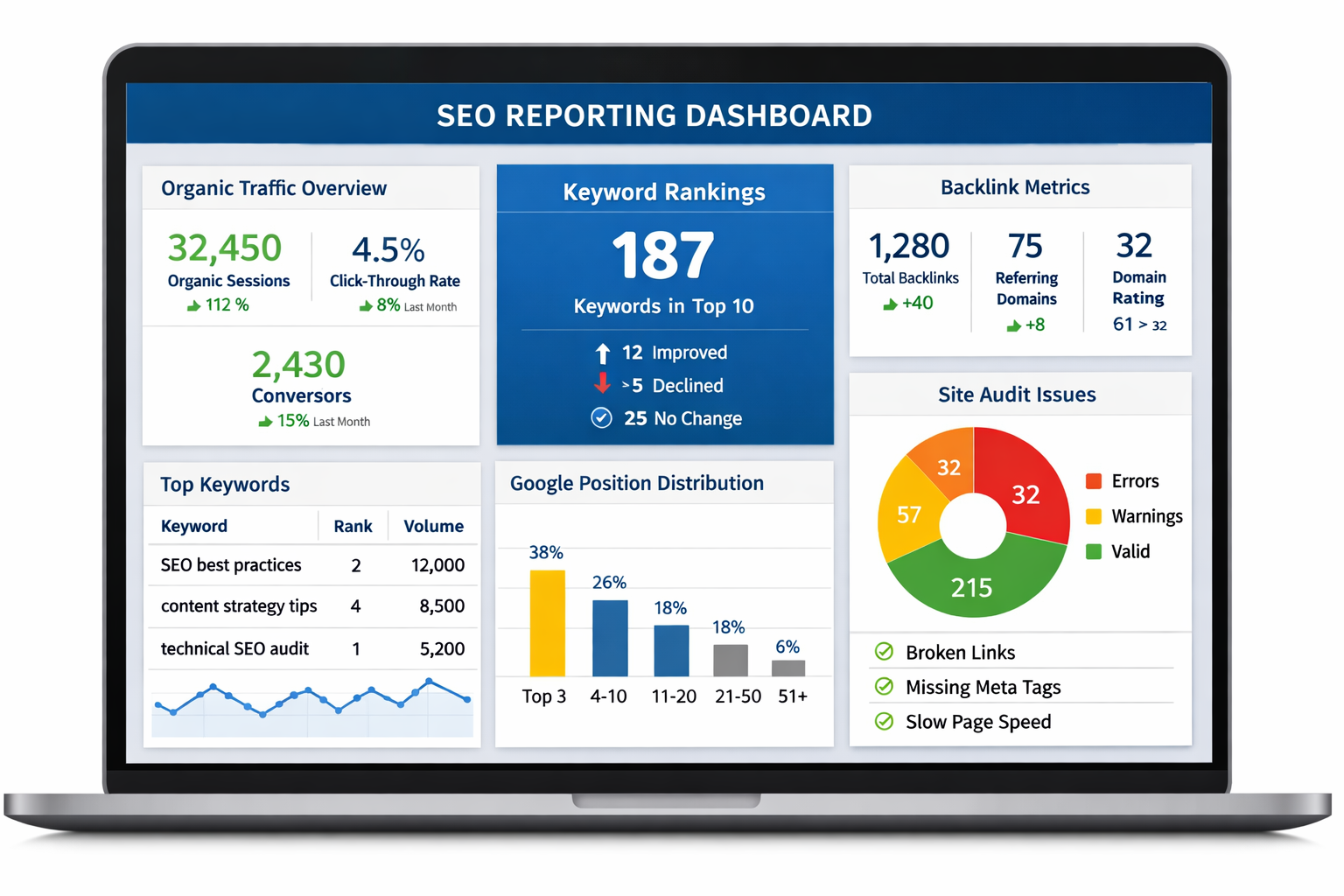
- Google Search Console (GSC) – free, essential. Shows clicks, impressions, CTR, average position, coverage errors, and Core Web Vitals. Set this up on day one of any site.
- Google Analytics 4 (GA4) – free. Tracks organic sessions, behavior, and conversions. Connect to GSC for a full picture of how search traffic converts.
- Rank tracking – Ahrefs, Semrush, or Mangools for daily keyword positions, competitor monitoring, and automated reporting.
Key SEO KPIs to track:
|
KPI |
Why It Matters |
| Organic Sessions | Baseline growth — is search traffic growing? |
| Click-Through Rate | Low CTR signals weak title tags worth testing |
| Average Ranking Position | Are your optimizations moving the needle? |
| New Referring Domains | Signals growing topical authority |
| Index Coverage | Are key pages indexed and accessible? |
| Organic Conversion Rate | Ties SEO to actual business outcomes |
Full technical and content audit every 6 months. Monthly, check GSC for crawl errors, review CWV status, and confirm that new content is indexed within 1 to 2 weeks of publication.
Prioritize fixes in this order: crawl errors → indexability → Core Web Vitals → content gaps → link opportunities.
Running an SEO Audit
A full SEO audit should be conducted every six months to uncover technical, on-page, and off-page issues. Monthly quick checks help catch problems early, such as broken links, missing meta tags, or slow-loading pages. When issues are identified, prioritize fixes that directly impact crawlability, indexing, and user experience, as these have the greatest influence on rankings.
Analytics also reveal how internal links distribute authority across the site. Linking new posts to strong existing pages accelerates visibility. Anchor text should remain descriptive and keyword-rich to guide both users and crawlers.
Common SEO Mistakes (and How to Fix Them)
- Targeting keywords with no clear intent match
Fix: Focus on aligning content with search intent rather than chasing high-volume terms.
- Thin content or duplicate content issues
Fix: Consolidate duplicates and expand thin pages with original, valuable information.
- Ignoring mobile and page speed
Fix: Optimize for mobile-first indexing and improve Core Web Vitals to enhance user experience.
- Over-optimizing anchor text
Fix: Use natural, varied anchor text that reflects context instead of exact-match repetition.
- Not building internal links
Fix: Add 3–5 descriptive internal links per page to strengthen crawlability and authority flow.
- Neglecting to update old content
Fix: Refresh outdated pages with new data, examples, and optimized formatting to maintain relevance.
- Chasing algorithm updates instead of fundamentals
Fix: Prioritize evergreen best practices, quality content, technical health, and authority signals over reactive changes.
The SEO Best Practices Checklist
Technical SEO
- XML sitemap submitted to Google Search Console
- No critical crawl errors in the GSC Coverage report
- Core Web Vitals passing on all key pages (LCP under 2.5s, INP under 200ms, CLS below 0.1)
- Site verified as mobile-friendly
- Site is fully on HTTPS
- Robots.txt not blocking key pages, CSS, or JS
- Schema markup implemented for the relevant content type
On-Page SEO
- Primary keyword/search intent in H1, title tag, meta description tag, URL, and first 100 words
- Title tag 50 to 60 characters, unique per page
- Meta description 150 to 160 characters, unique per page
- Short, hyphenated, keyword-rich URL
- Logical H1 to H2 to H3 hierarchy
- Alt text on every image
- Images compressed in WebP format
- Internal linking to relevant pages and guides
Content Strategy
- Keyword research done, volume, KD, and intent confirmed
- Intent matched to content format
- E-E-A-T signals present, author bio, original data, credible citations
- At least 3 to 5 internal links to cluster pages
- Content is comprehensive, original, and not thin or duplicated
Link Building
- At least 3 internal links pointing to this page from existing content
- Active outreach underway, digital PR, guest posts, or broken link building
- No paid or manipulative link schemes in use
- Backlink profile reviewed for toxic links in the last quarter
Analytics
- Google Search Console connected and verified
- Google Analytics 4 tracking key conversion events
- Rank tracking is active for primary keywords
- Monthly SEO review on the calendar
- Organic conversion rate tracked and benchmarked
Offer this checklist as a downloadable PDF lead magnet or publish it ungated as an E-E-A-T signal.
Conclusion
SEO in 2026 is a system, not a trick. Sustainable results come from combining technical precision, on-page optimization, content strategy, link building, and analytics into one cohesive framework. Each pillar reinforces the others, creating a cycle of visibility, authority, and measurable outcomes.
Technical SEO tips ensure that search engines can crawl and index pages effectively. On-page optimization makes content accessible and relevant. A strong content strategy builds topical authority and aligns with search intent. Link building signals credibility and trust, while analytics provide the data needed to refine and improve. Together, these five pillars form the foundation of long-term success.
The best starting point is a technical audit. By identifying crawl errors, index coverage gaps, and speed issues, the site gains a solid base for all other optimizations.