
Google E-E-A-T Explained: Why It Matters for SEO and Content Quality
Do you ever wonder why some web pages always manage to stay ahead in Google search engine rankings, whereas others lag behind, despite having comparable content and keyword targeting?
SEO is not limited to keywords, backlinks, and technical SEO alone. Google’s algorithm is focused on judging the quality and importance of content. What’s more, in its search for a better tomorrow, Google seeks to provide users with content they can trust.
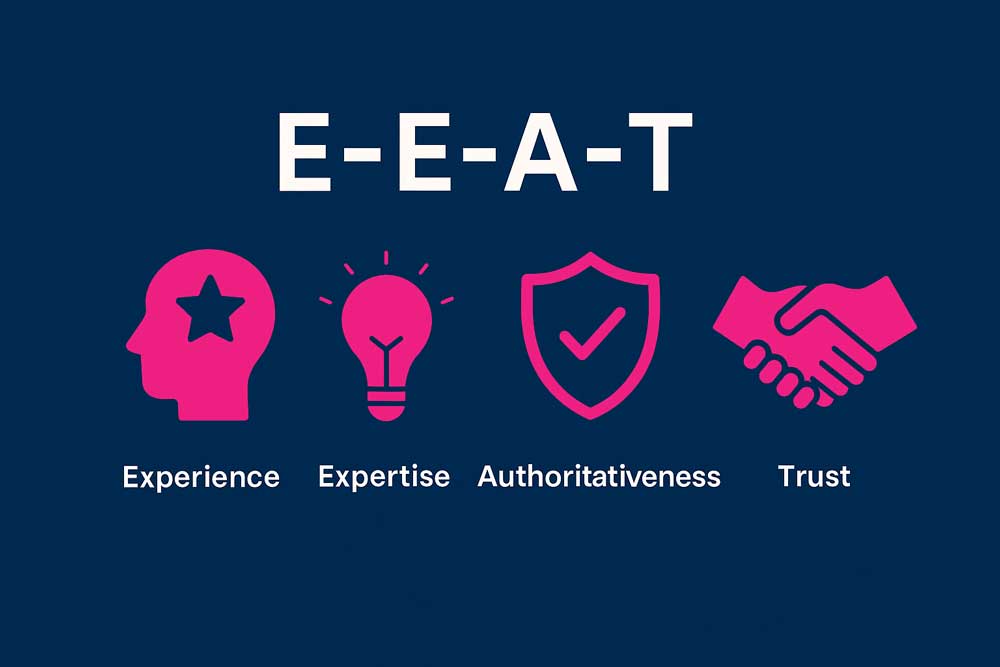
That’s where the concept of E-E-A-T becomes important: Experience, Expertise, Authority, and Trustworthiness. As one of the frameworks outlined in Google’s Search Quality Rater Guidelines, E-E-A-T serves as a useful definition for quality content in Google’s view. In 2022, Google added another ‘E’ to this framework: Experience.
Although E-E-A-T is not directly used to rank pages, it does affect how Google views the quality and credibility of that content. Being aware of and following these criteria will allow companies to develop credible content that wins the trust of their audiences.
Why Google E-E-A-T Matters for SEO
With its focus on E-E-A-T, Google is able to highlight the most dependable, trustworthy, and valuable information regarding any query.
This will help users receive better search results. At the same time, it helps brands and content creators who are putting effort into establishing their expertise and authority in their field.
E-E-A-T becomes especially important for the so-called YMYL webpages. In case of YMYL content, people require that their data be trusted. The data provided by the authors with direct experience tends to seem credible and reliable.
Yet the necessity of E-E-A-T goes way beyond YMYL content. People appreciate information provided by knowledgeable authors who have actual experience in any particular area of interest.
Read More: What is GEO? Guide to Ranking on ChatGPT, Perplexity, and Google AI
Reasons Why E-E-A-T Matters for SEO, AEO & GEO
-
Ranking, Citation signals, and content quality
Google checks how well content follows E-E-A-T principles, and stuff that does tends to rank higher in searches. This boost in ranking and citation really matters for a site’s visibility.
-
Effect on visibility in search results & AI overview

Source Image:- iplocation.net
With strong E-E-A-T signals, websites have a better shot at landing those top spots, especially for terms that get lots of competition. If the E-E-A-T is weak, though, sites might miss out on prime real estate in search results and AI overview.
-
User involvement and trust
People stick around longer and come back to sites more when the content shows expertise and trustworthiness. This boosts search performance too, making the site rank better.
-
Google’s Guidelines for Quality Raters
Google’s human quality raters use E-E-A-T to judge content, even if it’s not an official ranking rule. They help tweak search algorithms to favor trustworthy and valuable stuff, making the internet better for everyone.
Understanding Each Part of Google E-E-A-T
1. Experience
Experience relates to the direct involvement of the content creator in the subject under discussion. The inclusion of experience by Google was done in 2022 because it recognizes the importance of practical experience that one does not get from school or study.
For example, an individual who describes his experience of going to a particular place, a person who reviews products he has been using, and an individual who discusses the lessons he learned while working on a project all illustrate experience. These forms of content usually contain facts not found in general articles.
2. Expertise
The expertise is the measure used to indicate how deeply the content creator is versed in their subject. For content that affects an individual’s health, finances, safety, and well-being, Google values expert information much more.
For example, any medical information should preferably be provided by qualified doctors, and legal or financial material should preferably be provided by legal or financial professionals. But it is not necessary that expertise comes only from qualified persons. Anyone who has done years of research and experience in a particular niche will surely qualify for an expert.
3. Authoritativeness
Source Image:- figmentagency.com
Authority ties into reputation. The answer to the question is this: Does the wider industry know that this individual, organization, or website is a credible source for information?
Authority can take time to build based on publishing, recognition within the industry, and endorsements by other authorities. While the website might show knowledge, the real authority comes when others confirm that knowledge.
For example, a cybersecurity company quoted by top technology media sources or a healthcare site referred to by reputable medical sources illustrates authority in that particular field.
4. Trustworthiness
Trustworthiness is regarded as the most critical element of E-E-A-T since even the most experienced or authoritative sources may become less reliable if their trustworthiness comes into question.
Google wants its users to be sure that the information they consume is accurate, open, and secure. In other words, the concept of trust relates to both the content and the site as a whole.
For example, websites that clearly identify the author, offer correct contact details, ensure user data security, and adopt business practices that are easily understood are considered trustworthy.
Google Search Quality Rater Guidelines E-E-A-T
These raters do not have any direct role in the ranking process. Yet, their observations can help Google refine its algorithms.
These guidelines help to understand how Google defines the following terms.
- High-quality content
- Useful information
- Spamming or poor-quality web pages
- Reliable websites
- User-centric web experience
Google says focus on content generation that targets users and not search engines.
Good E-E-A-T content is if you have clear authorship, accuracy, reputation, user value, and transparency.
In other words, SEO is not all about optimization in the technical sense. It also involves building trust.
How to Improve Google E-E-A-T on Your Website
1. Create Authoritative Author Profiles
Detailed Bios
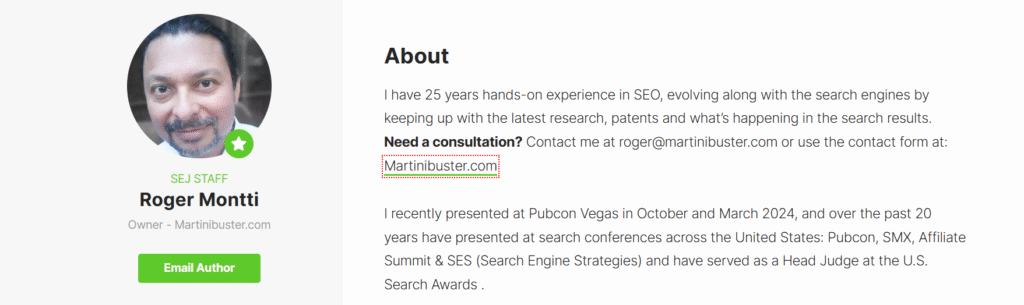
Each piece must feature an author bio giving a background of the author, the author’s qualifications, and the author’s experience in the subject area.
For example, if writing an article about financial planning, the author bio would mention the author’s experience as a financial planner and relevant certification. If it’s a travel blog, the author’s bio would list places the author has visited.
2. Author Schema
<script type=”application/ld+json”>
{
“@context”: “https://schema.org”,
“@type”: “BookSeries”,
“name”: “The Hitchhiker’s Guide to the Galaxy”,
“genre”: “comedy science fiction”,
“startDate”: “1979-10-12”,
“endDate”: “1992-10-12”,
“abstract”: “Earthman Arthur Dent is saved by his friend, Ford Prefect—an alien researcher for the titular Hitchhiker’s Guide to the Galaxy, which provides info on every planet in the galaxy—from the Earth just before it is destroyed by the alien Vogons.”,
“author”: {
“@type”: “Person”,
“givenName”: “Douglas”,
“familyName”: “Adams”,
“additionalName”: “Noel”,
“birthDate”: “1952-03-11”,
“birthPlace”: {
“@type”: “Place”,
“address”: “Cambridge, Cambridgeshire, England”
},
“deathDate”: “2001-05-11”,
“deathPlace”: {
“@type”: “Place”,
“address”: “Santa Barbara, California, United States”
}
}
}
</script>
The schema for an author helps the search engine understand the author behind the content and link this person to his/her credentials and works.
For example, linking the author profile page with the person’s LinkedIn page or industry magazines with your publishes articles in.
3. Add Expert Reviews for Sensitive Topics
For industries like medicine, finance, or law, you may want to add a process where your content goes through an editor.
Example: Your medical piece can include something like,
“Reviewed by Dr. Sarah Smith, Board-Certified Dermatologist.”
It shows that professionals have reviewed your content for its accuracy.
4. Demonstrate First-Hand Experience
Instead of limiting yourself to providing an account of facts found elsewhere, try to include insights gained, difficulties encountered, and other relevant observations.
For example, if you write a review on some software, you need to talk about your test results, problems with usability, pluses and minuses, and examples of how it works, but not rehash what is said about it on the company’s official website.
5. Use Original Photos, Videos, and Screenshots
The use of visual aids will provide evidence and prove authenticity.
They include the following.
- Photos of products tested
- Screenshots highlighting features in operation
- Results before and after projects
- Travel photographs of locations you have personally visited
- Video demonstrations of product performance
Use of original material will help your work differentiate itself from other organizations that post generic information.
6. Build Topical Authority
Instead of writing standalone articles, group articles by topic clusters and content hubs.
Example:
A website for digital marketing may create an entire SEO cluster that will cover articles about the following.
- Keyword research
- On-page SEO
- Technical SEO
- Link building
- Local SEO
- E-E-A-T practices
Such organization proves expertise in the subject matter and guides users to further content.
7. Publish Original Research
Original research can be among the most powerful tools for building authority since it generates information that is not available anywhere else.
Include industry surveys, studies on customer behaviors, reports on market trends, analysis of proprietary data, and studies with quantifiable results.
For example, if an advertising firm were to release a study showing a statistical correlation between website rankings and author identification, others could cite and link to that research, reinforcing authority signals.
Future of Google E-E-A-T
As the Google algorithms growing, E-E-A-T will become more important.
This is because search engines are now more focused about the trustworthiness of websites, authenticity, reliability, and experiences.
In other words, quality will win.
So, it is time to stop focusing on SEO tricks and focus on giving customers better.
Wrapping It Up
Google E-E-A-T is not just another SEO trend. This is Google’s attempt to make content better and increase trust among its users on the internet.
If you have a blog, business website, or an online store, improving E-E-A-T scores will help you gain more users.
The most important thing for the best SEO services is to produce useful content that is useful.